
Returnable Packaging Blog
Designing Returnable Packaging for the Modern Manufacturing Floor
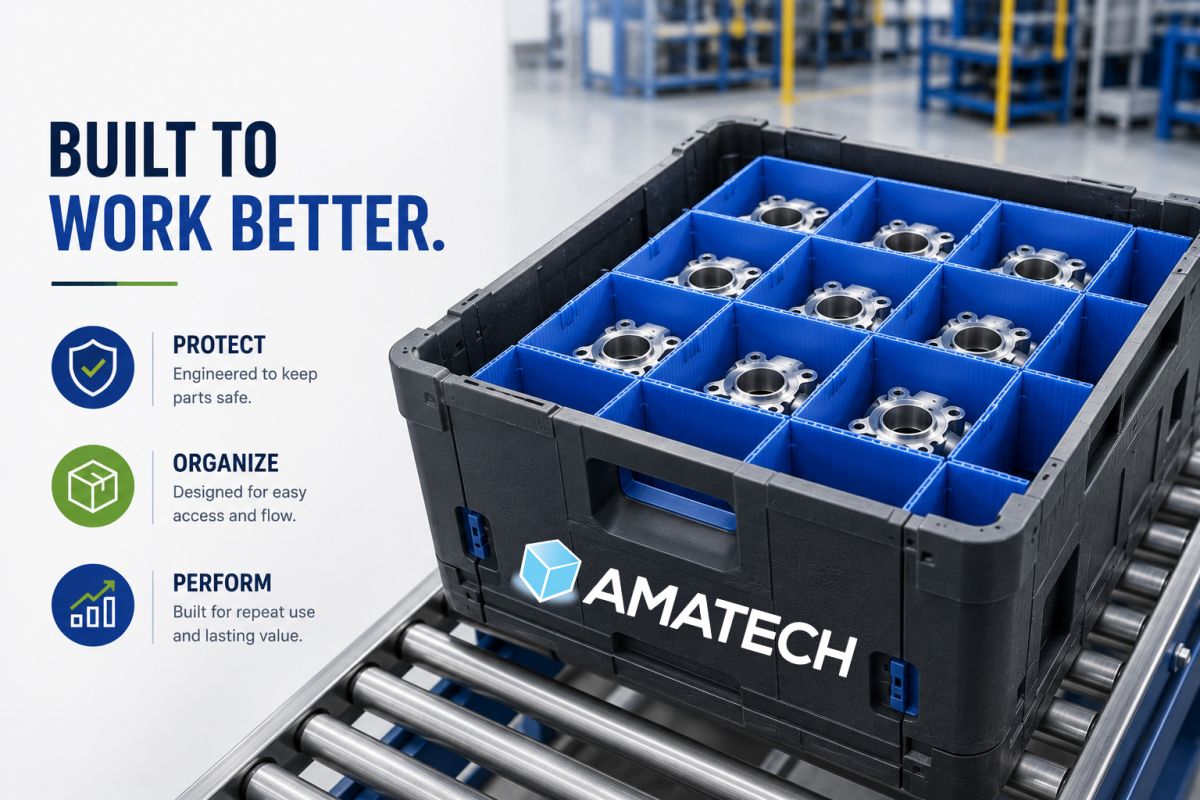
Manufacturing is becoming faster, more automated, and more connected. As production environments evolve, packaging has to do more than protect a part during transportation.
Today, returnable packaging can play an important role in how parts move through a facility—from receiving and storage to the production line and final shipment.
When packaging is designed around how parts are actually handled, it can improve material flow, simplify operators' tasks, and help manufacturers build more efficient processes.
At Amatech Inc., we design custom returnable packaging and dunnage around the part, the process, and the people using it.
Packaging Should Fit the Process
A standard container may hold a part, but that doesn't necessarily mean it's the right solution.
Manufacturers have different requirements for part orientation, presentation, handling, stacking, transportation, and storage. A packaging system that works well for one application may create problems in another.
Custom returnable packaging allows the packaging to be designed around those specific requirements.
A well-engineered system can help:
- Present parts in a consistent orientation
- Keep components separated and protected
- Make parts easier to access
- Maximize available container space
- Simplify loading and unloading
- Improve material flow throughout the facility
The goal isn't simply to create a container that works. It's to create a packaging system that works with the process.
Making Part Presentation More Efficient
Part presentation is an important but often overlooked part of manufacturing efficiency.
When components arrive randomly positioned in a container, operators may have to search, rotate, reposition, or sort parts before they can be used. Those extra steps can add up over thousands of production cycles.
Custom dunnage can create designated locations for each component, giving operators a predictable and repeatable way to access parts.
Foam, corrugated plastic dividers, trays, inserts, and other dunnage configurations can be engineered around the geometry and handling requirements of the component.
Learn more about what dunnage is and how it supports returnable packaging.
Designing for the People Using It
Packaging design isn't only about the product. It's also about the person interacting with it.
If operators repeatedly lift, reach, bend, rotate, or unload containers throughout the day, packaging design can have a meaningful impact on their workflow.
Thoughtful packaging design can help improve ergonomics by:
- Making components easier to reach
- Reducing unnecessary handling
- Keeping parts organized
- Providing consistent access to components
- Designing containers around the way they are loaded and unloaded
Small improvements in repetitive tasks can make a big difference across an entire production operation.
Making Automation Easier
As manufacturers introduce robotics, automated material handling, and other technologies, consistency becomes increasingly important.
Automation works best when parts arrive in predictable positions, and packaging can be handled consistently.
Returnable packaging systems can be designed with automation in mind, helping create repeatable part presentation and standardized container configurations.
This can make packaging an important part of an automated material flow strategy rather than something that has to be worked around.
Protecting Parts Throughout the Journey
Efficiency doesn't matter if parts arrive damaged.
Components can encounter vibration, movement, stacking forces, and repeated handling as they travel between suppliers and manufacturing facilities. Custom dunnage helps keep components separated and secure throughout that journey.
Depending on the application, Amatech can incorporate materials such as:
- XLPE foam
- Corrugated plastic
- Laminates
- Fabric
- Custom inserts and dividers
The right combination depends on the part, environment, handling requirements, and expected returnable packaging cycle.
For another look at the advantages of reusable systems, explore the benefits of returnable packaging.
Built for More Than One Trip
One of the biggest differences between expendable and returnable packaging is the way the system is evaluated.
A disposable package is often judged by its initial cost. A returnable packaging system needs to perform repeatedly.
That means durability, repairability, cleanability, stackability, storage, and ease of handling can all become important considerations during the design process.
When properly engineered, reusable packaging can help reduce the ongoing demand for expendable materials while providing a consistent packaging solution over many trips.
A Better Connection Between Packaging and Production
The best packaging solutions don't exist separately from the manufacturing process. They become part of it.
From the way a supplier packs components to the way an operator removes them at the production line, every interaction presents an opportunity to improve efficiency.
That's where custom returnable packaging can make a difference.
At Amatech Inc., we work with manufacturers to develop packaging and dunnage solutions designed around their specific components, processes, and handling requirements. Whether the priority is part protection, ergonomics, automation, space utilization, or long-term reuse, the right design can help create a more efficient flow of materials.
Better Packaging Starts With Better Design
Your packaging shouldn't force your process to adapt to it.
It should be designed to support the way your operation actually works.
Amatech Inc. provides custom-designed returnable packaging and dunnage solutions for manufacturers looking to improve protection, efficiency, and material flow.
Have a packaging challenge? Let's design a solution around it.